
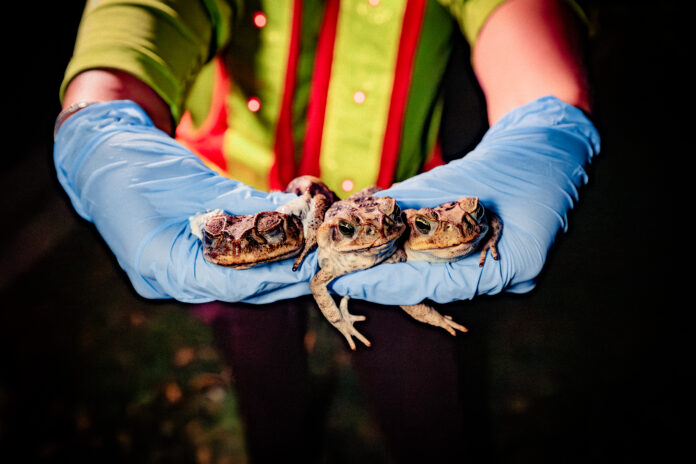
As twilight falls over South Florida communities, a different kind of patrol begins. Beneath the swaying palms and neatly trimmed hedges, Jeannine Tilford, flashlight in hand and headlamp aglow, moves silently across lawns and storm drains. But she’s not hunting criminals—she’s after toxic invaders. As the founder of Toad Busters, Tilford has become one of the most passionate and visible figures not only in Florida, but the nation, to fight against invasive species and to save pets’ lives.
The Invasion Problem
Florida is no stranger to non-native intruders. With its subtropical climate and bustling trade ports, the state is an ideal gateway for invasive species from around the globe. Among the most dangerous are the toxic cane toad, the parasitic New Guinea flatworm and the aggressive Cuban tree frog—species that are not only outcompeting native wildlife but also posing serious threats to pets, humans and local ecosystems.
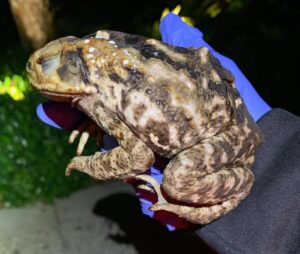
“These species don’t belong here,” says Tilford. “They have no natural predators, they reproduce rapidly and they’re devastating native species.” Cane Toad, also called bufo toads, are especially dangerous to pets. Native to South and Central America, these amphibians were introduced for agricultural pest control, but quickly became a hazard. Their toxic secretions can kill dogs in minutes. “I’ve seen too many families lose their beloved pets to these toads. It’s heartbreaking,” Tilford said.
A Mission Becomes a Movement
Tilford, a former school teacher who specialized in ecology, environmental science and zoology, didn’t set out to become a frontline warrior. But witnessing firsthand the ecological damage—and emotional toll—spurred her to action. What started as a one-woman mission has evolved into Toad Busters, a full-scale ecological strike team working across Florida. Her company operates in South Florida up through central and northern Florida, offering home inspections, removals, protective fencing and pet poisoning emergency kits. “We’re not just here to remove the toads,” she says. “We’re here to teach people how to identify them, how to protect their pets and how to become part of the solution.”

On a single night, Tilford and her team can capture dozens—sometimes hundreds—of cane toads. Each one is euthanized using humane, FWC-approved methods. “There’s no glory in this job. It’s dirty. It’s exhausting. But it’s necessary.”
More Than Just Toads
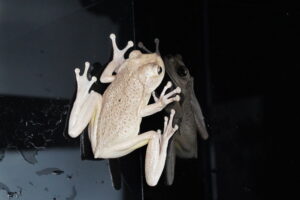
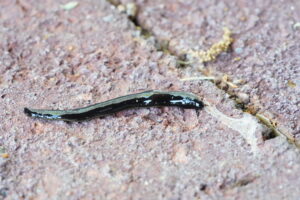
While cane toads are the poster villains, they’re not alone. The New Guinea flatworm, a slimy black predator that feeds on native earthworms and carries a parasite that can cause meningitis in humans, has been spotted throughout Florida. And the Cuban tree frog, with its voracious appetite and sticky toe pads, is displacing native frogs and climbing into homes, toilets and even car engines.
“These aren’t just nuisances—they’re ecosystem wreckers,” said Tilford. “If we don’t act now, we may never get our biodiversity back.”
The Human Element
Perhaps what sets Tilford apart is her compassion—not just for animals, but for people. Many of her clients find her after losing a pet or experiencing a backyard invasion. “I’ve had elderly residents call me in tears because their dogs died after licking a toad. We come in, help them feel safe again and make sure it doesn’t happen again. Prevention is far cheaper than eradication,” said Tilford.
Raising Awareness, One Toad at a Time
With a growing presence in the news and social media, Tilford’s visibility has made her a go-to expert on invasive species. Her website, ToadBusters, offers educational materials, FAQs, and services for homeowners across the region.
She regularly appears in media markets across Florida and the United States, highlighting the dramatic rise in toxic toad sightings due to warmer winters and increased rainfall. “It’s not just about science,” she says. “It’s about protecting the pets and places we love.”
How to Identify a Poisonous Cane Toad
Cane toads can be gray, yellowish, olive-brown or reddish-brown, and have pale undersides with dark blotches. They have rough, dry and warty skin and typically sit in an upright position. Their heads are bony, featuring ridges above the eyes. The back feet are partially webbed with tough, leathery skin, with the front feet lacking webbing. Just behind their eardrums are notable swellings, which contain the toxic secretion. Compared to native frogs, cane toads are less capable of jumping high, fast or far.
A Call to Action
Tilford urges Floridians to become citizen scientists: reporting sightings, joining nighttime toad walks, and modifying landscaping to deter breeding. “If everyone did just a little, it would make a massive difference,” she says. “This isn’t a fight I can win alone.”

To learn more or report an invasive species sighting, visit www.ToadBusters.com.

